Candy Dulfer & Stephen Emmer
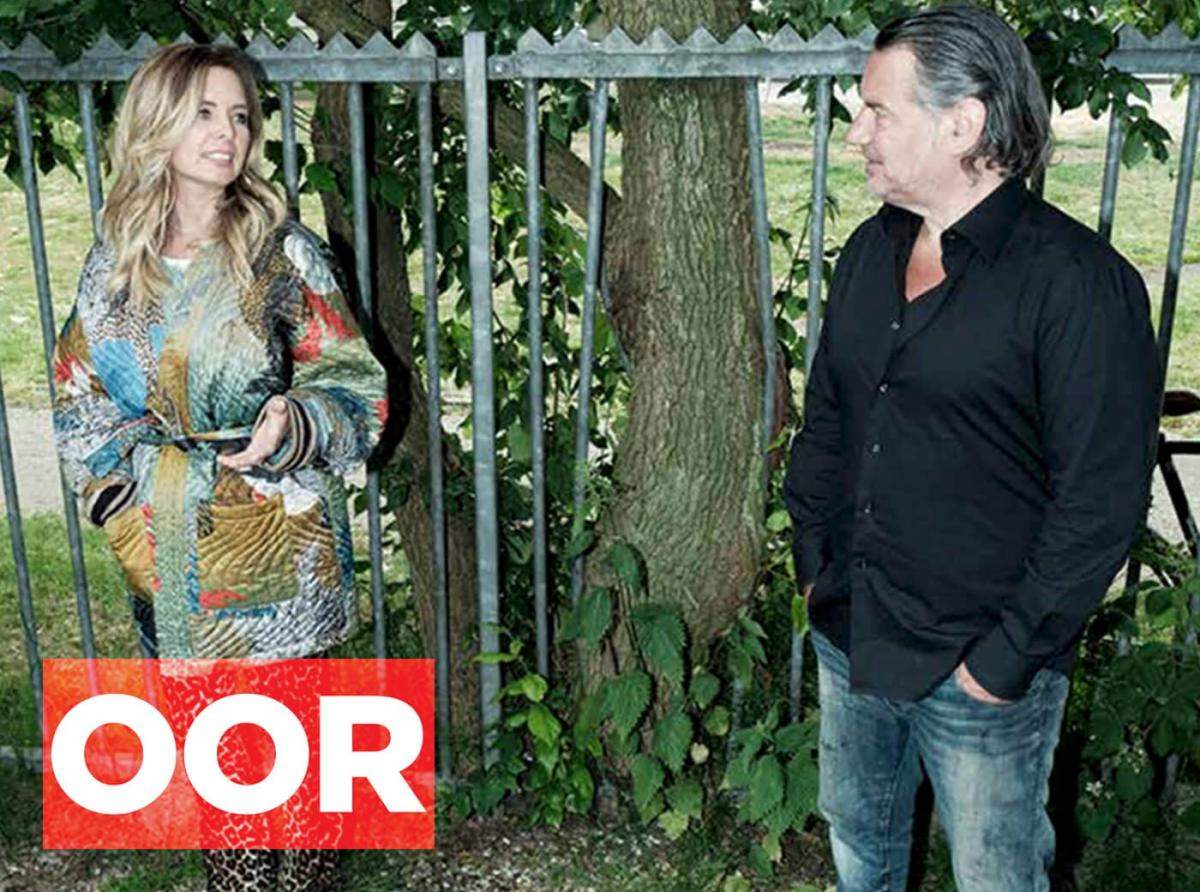
Candy Dulfer is two minutes late. A rarity, according to the filmmaker who follows her all year round. But even as one of the world's most famous saxophonists, sometimes you can't find a parking spot in Amsterdam-North. And, just when it is raining heavily, you will have to walk a bit. Stephen Emmer doesn't mind. As the most frequently heard musician in the Netherlands (once Ultra band Minny Pops, now the man behind hundreds of TV theme tunes, including those for the NOS Journaal and RTL Nieuws), he proposed this meeting.
Candy streamed music from her kitchen during the pandemic, while Stephen composed the neoclassical Maison Melody in the isolation he was already accustomed to. Once inside on the couch, the calm Stephen (composed, as you would say in English) and the driven Candy (who, as usual, blows everyone away) turn out to have a lot in common: here sit the creators of the two most famous saxophone sounds our country has ever produced – RTL Boulevard and Lily Was Here – at a distance of one and a half meters.
Fake Sax
Candy: ‘I’ve done it once, when I was on Boulevard. Tatadadadaaa!’
Stephen: ‘Haha, I mentioned that just this spring, in my acceptance speech for the Buma Oeuvre Award. It is remarkable that Candy Dulfer, a real saxophonist, played it live once. You see, I used a fake sax. I still find it striking that the audience embraced this particular piece so much, out of all the things I’ve made.’ The count is around nine hundred now. My personal favourites are usually the more complex ones, although sometimes they’ve already disappeared from the screen after just three Teleac episodes. That really seems like an artist thing to me: something you just made is suddenly called iconic, while you yourself are thinking: huh, so this is it? Did it go like that with Lily Was Here too?
Candy: ‘Oh yes. It wasn’t the plan at all. I was seventeen and not nearly ready for that yet. If I had a strategy at all, it went completely awry because of that song. I wanted to become a mix of Hans Dulfer, Maceo Parker, and David Sanborn and only play that kind of music. North Sea Jazz was a dream, and maybe a trip to America someday. I did all of that within a year back then. I just about managed the project with Dave Stewart; I thought film music was stupid. Seventeen, you know. Stupid! Although I did like Dave’s approach. He had a few excellent jazz musicians around him in a studio in London, who improvised on the images they were watching. Afterwards, I was already sitting with my mother waiting for the taxi to the airport when Dave came back: he had one more piece I had to play. I quickly put my sax back together, not quite right either; he started with that tune, I played a little variation on it. Just like that, done, I had to catch a plane.
The piece didn't do much for me; there was no funk or soul in it either. I never thought about it again, until a few months later someone called: you were on the radio, with that man from Annie Lennox! Lily Was Here shot to number 1 in one go. And I indeed thought: huh, this one? Is this it? For the first few months, I still apologised. I hated it! I didn't play it at gigs for the first five years either. But of course, I grew up, and only then did I understand that that composition is so good because the audience made something of it. Since then, that solo has taken on a life of its own, even when I play it now. Because actually, I can never remember it and I prefer to just go my own way.’
Rubik's Cube
Stephen: ‘I’ve gone through the entire spectrum of styles in many bands. Symphonic, free jazz, electronic noise, making things difficult... I have to construct it down to the square millimeter. So that, ultimately, it can be solved in ten seconds, like a mini musical mosaic—like a sort of Rubik’s Cube. What I’ve taken away from that is a different belief in free music. Music has to be structured, preferably fully written out, including the solo. I think that is diametrically opposed to your perspective.’
Candy: ‘Yes. I inherited from my father that it’s actually not about the songs, but about what we can do with them. When my friend’s children are home, a lot of hip hop is played. They said very quickly: we listen to it, but you’re constantly making up new melodies. That’s true; I hear Roddy Ricch and immediately think of what I would play if I were on stage with him. At the same time, I am very bad at remembering things.’ Lyrics, solos, even melodies – I barely retain the details. But associatively, I can let loose completely.’
Stephen: ‘Well, you are an instrumentalist, of course, with a certain virtuosity. I am not: competent on the keyboards, competent on the bass. It will do, to achieve the goal: the composition. In that, I have also never felt the freedom of improvisation, like you can. I am a laboratory technician, just like those guys from Steely Dan were, for example.’
Candy: ‘But the moment you compose, isn’t that the greatest improvisation?’
Stephen: ‘That’s right. Out of nowhere, something suddenly appears. For me, that is the focal point of skill and also of the experience. Everything after that is oh fuck! Recording. Performing. I have never been a stage animal.’
Candy: ‘I’m not that good at making records, but I love the whole songwriting process. Sitting there, watching it grow.’ And then I end up putting off my solo for months, because that is, of course, the icing on the cake. If it isn't that amazing, then that is the absolute worst. Although that is subjective too, as you can see with Lily Was Here. I managed to play it exactly as it was for a while, but now we’ve changed the chords a bit again and it’s going in all directions again. Every night I think to myself: I’m going to give the people tonight the melody they want so badly. And after five bars, I’ve lost it. Most people don’t mind, but I also have very old fans; I see them look very hopeful for a moment at the first notes and just like that, there I go again. Oh well, you can see them thinking, at least she tried again. I just love improvising.’
The Old One
Stephen: ‘Funny that we never met before. Even though we have a lot of mutual acquaintances. I know a lot of people who played with you.’
Candy: ‘The music world is a small one. Of course, I know damn well who you are. The mother of Nada van Nie, my childhood friend, did know your father. And I think my mother has met him once too. Because of our fathers’ legacy, you know a lot more people anyway.’
Stephen: ‘Even though we are both self-made. Entrepreneurial, too.’
Candy: ‘I see you pop up on social media regularly; you are very good at presenting and promoting yourself. I like stayers anyway, people who just keep going. That’s something I’ve always noticed about you. How old are you, actually?’
Stephen: ‘62. Older than you, in any case.’
Candy: ‘But those fathers, you can hardly get around them.’ No matter how self-made you are, you always run into that love for your father again. So many women say to me: 'Oh, your father is such a nice man!' What am I supposed to do with that?, I usually thought. But now I’m saying to you again: Fred Emmer was the best news anchor, after all. You’ll just have to learn to live with that, haha!’
Stephen: ‘Yes, that is indeed part of it. The Johnny Kraaijkamp junior effect, I call it. I have a sort of love-hate relationship with it. And now we’re talking about that old guy again.’
Candy: ‘Nice, isn’t it?’
Stephen: ‘Yes, actually it is.’
Plateaul Boots
Candy: ‘How long ago did he pass away?’
Stephen: ‘Christmas Eve. But I feel like I still know what he’s thinking. When I look in the mirror, I just have to tap and I know how he would feel about something. I still have a scarf of his, too. The scent really lasts a super long time. Half a year later, you can still smell it: hey, that’s him.’
Candy: ‘Oh, I have that with an old pair of my grandpa’s pajamas. But luckily, I still have both my parents. What I do wonder, though: would it be harder to be the son than the daughter, in the case of fathers?’
Stephen: ‘I think there’s more toughness involved in father-son relationships that isn’t necessary. My father was quite authoritarian, but also a rebel. I do believe there is a different dynamic in being the son or the daughter.’ If you look at the transmission in your case, the music went from him to you. In my case, the music came mainly from my mother [actress Roekie Aronds]. She is 92 now. She used to be a dance teacher, a singer, and had a role in Pension Hommeles, the first Dutch soap opera. In that show, she was the one for whom Donald Jones sang: "I would most like to put you in a little box." I lived with her in Suriname; she taught dance there, to Santana, exotic things from Brazil, and voodoo music from the Caribbean. As a boy from ten to thirteen, I was completely immersed in her musical choices, which were very defining. So, in my case, it doesn't come from my father. Although he was a bigger soul man than I am. We even went to see Marvin Gaye together. After his passing, I found a very old cassette player with a tape still in it. I took a quick look to see what it was: Barry White. And when there was a parents' night at my posh school, he was the only one walking around in platform boots instead of a blazer. Back then I thought: just act normal! Now I mostly see a total individualist. Yes, proud of him.’
Flowers
Candy: ‘We lived in a village and Hans and Inge naturally looked very different. My mother had bright red hair, my father also sold cars alongside his music. I never had to be ashamed of my parents back then. Even though the contrast was clear, it was mainly farmers living there. It was a nice village, everything was mixed together. No problem. I also went along with them to nightlife venues a lot, even at a very young age. When I started going out on my own with my girlfriends, starting to discover my own little world, Hans was always über-concerned. My school was a five-minute walk, through the village, and yet I was driven there every morning. And when I went dancing with Nada on Sunday afternoons at De Bok in Buitenveldert, I was dropped off and picked up too. ‘Is that your father?’ I would hear at five o’clock, even though we had agreed on six. There he stood, swaying along a bit. But he loved it. So I didn’t mind it that much.’
Stephen: ‘You didn’t have to rebel against it?’
Candy: ‘No, although I did make an attempt once. Who am I then, and shouldn’t I break free for once? People around me said that last part too. But I thought: why? They’re really nice, aren’t they? And it’s my decision. I think I ultimately just became myself, without having to force a break. Not in the normal, rebellious way. The only thing I was really able to shock my parents with was when I was asked to enter the Interlyceale, one of those competitions for all those posh schools, even though I didn’t go to one of those schools at all. One of those competitions was in art; they had roped me in as a saxophonist. So there I stood, wearing one of those club ties, you know the kind…’
Stephen: ‘Those hockey colors, yeah.’
Candy: ‘That was the only time my father said: is this really necessary? Loafers and a tie like that, haha. I was almost disinherited. I do have to say that I’ve always been very critical of them, which perhaps wasn’t always a good thing. As an only child, I’m sometimes a sort of referee, the third adult in that marriage. And they usually listened to me, too. A strange dynamic, though it didn’t cause any lasting damage. In fact, they are still together, and in all its ups and downs, that apparently works out fine. I was once on the verge of moving into another house with Inge. To hell with him, you have to do this and that… But then Hans would show up on the doorstep again, with a bunch of flowers from Esso. Everything was fine again. And that’s how it’s always been. An insane journey.’
Stephen: ‘My father asked once: what do you think, should I get a divorce? That wasn’t about my mother back then, mind you; they were already separated. A whole procession of step-parents followed, with me sitting in the middle. But how old must I have been… twelve or so? That was quite a decision. How long have Hans and Inge been together now?’
Candy: ‘Well… forever. They were fifteen and sixteen and Hans’s best friend said: will you or will I take her along on the bike? So she sat on the back of Hans’s bike. And that’s still going on. My father is a very special man; you simply can’t not love him. Not an easy mom.’
Freedom
Stephen: ‘Your father is also such a stayer. A trouper. Someone who just keeps going. How many colleagues have thrown in the towel when things were going badly for a moment… I think Hans has been making his mark for about sixty years now?’
Candy: ‘Since he was seventeen. He turned eighty last week. Do the math.’
Stephen: ‘I can certainly understand that you might lose your bearings for a while during a difficult period. But if you love the music, after all? Then it’s no wonder you’ve been around for sixty years. I once put a relationship at stake by saying that the muse is always number 1 for me. Oh dear, so I’m not your number 1? Well, it’s not that hierarchical, but I actually have another relationship.’
Candy: ‘So that ended up being a bouquet of flowers from Esso…’
Stephen: ‘It is just very clear to me: music has become my oldest partner.’ It’s here to stay, for me. Until death do us part. Just like Hans is still carrying on. People who are mainstays, I believe in that, I love that. I just hope the current situation doesn’t claim too many victims in that area.’
Candy: ‘It was also very difficult not to suddenly be able to see someone who is always there and just keeps going, because of the quarantine. Not even on the phone, because for the first few weeks I would start crying immediately, and so would he. After a month or so things improved a bit; I saw him being healthier, tanner, and more relaxed than ever. He could finally sort through his old photos. Well, suddenly not being able to play every day anymore, doing what you do and what you live for? Fortunately, I saw that he could sometimes enjoy that peace. And the next day he would be angry again and swear all over Facebook. Ultimately, the greatest thing we had was taken from us, the only and best thing we can do. Something that goes much further than just making music: we want to be able to help our friends. My father and I have been fighting for the musicians around us our whole lives. I am very used to solving things with money. Oh shit, here, I’ll just pay your rent for a month. Or just take a taxi. That’s the Dulfer-nonsense freedom. That’s gone now. And that sucks so much!’
Soldiers
Stephen: ‘We are both entrepreneurs, you know. And in music, that is anything but a given. There are so many creative people who don’t want to do that or simply can’t. That is going to be a tough one. After all, they aren’t doing anything wrong, yet they are now in danger of being hit the hardest. Very sweet people, who just love their instruments and do beautiful things with them. Which, suddenly, wouldn’t be enough anymore. Because they aren’t commercial. Will those people make it to Christmas?’
Candy: ‘Yes, the real musicians. The soldiers in the army. Who aren’t busy with project X or Y and whether they’ll appear on TV, but just want to make music. You and I have to rely on the guys who practice their bass guitars at home for six hours and then come over to play whatever we get our heads up. The fate of those people isn't fully understood yet.’
Stephen: ‘A whole army of defenseless people, yes. Really.’
Candy: ‘I would have loved to give all my band members ten thousand euros right now. But just before the crisis hit, I had invested my buffer in other things. That, too, is being an entrepreneur. It came at a bad time. If nothing happens now, my company will go bankrupt in December. Maybe that’s what we’ll have to do then; we’ll get over that too. However, the approach to musicians in the Netherlands right now is piling mistake upon mistake upon mistake. I am very angry about that. See it as a challenge, be creative, you hear. Yeah, hello! That is what we always do! Our whole life. Because we take risks and invest every time, we don't have a penny to survive a pandemic. And now – the so-called lack of – creativity suddenly comes around the corner to put us back in our cages? We have always been expected to do all sorts of things for free. And now it’s a pandemic, and that is yet another stick to beat us with. Be creative, you stupid little musician! No. Moreover: we are residents of the Netherlands, have always paid our taxes properly, and are therefore entitled to support now. That is something I am fully committed to.’
Stephen: ‘You could argue that there is a certain naivety among those true musicians, who are not focused on corporate matters. But that is a genuine naivety. And now everything is falling away, and those people are sitting there suffering in silence in their little houses.’
Candy: ‘That is why I stand up for those guys, for whom hardly any lobbying is being done right now. We have to get rid of the idea anyway that if you haven't come up with a very smart, creative solution later on, you’ve done something wrong. It is not a story of winners and losers, or at least, it shouldn't be.’ There is certainly a race going on, because this cannot continue like this for much longer. However, it is not about who comes out on top, but about ensuring that at the end there is something that benefits us all. Surviving and continuing to look out for each other a little. That is my struggle.
[OOR Magazine - Willem Bemboom]