Individuality, balance and the pure music
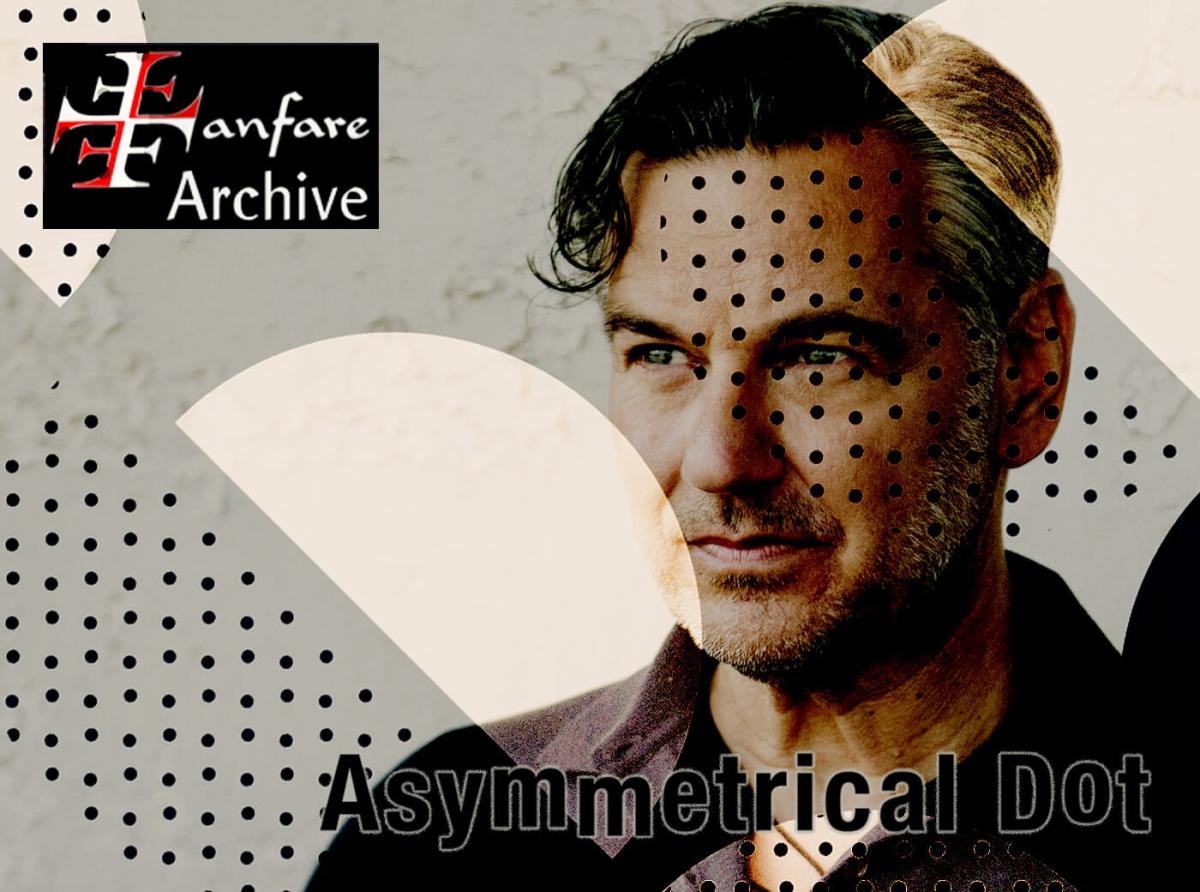
Listen to the piano opening the gorgeous In Situ, the penultimate track on Stephen Emmer’s new album, Asymmetrical Dot, for one of his approaches to the instrument. Its mechanics are certainly present, but the actual note being struck is deep and clear, nearly pure. Then, dig into Asymmetry, Emmer’s homage to David Lynch, for an altogether different take on what I’m taking to be the sound of a piano. It warps, bends, reconfigures itself and returns to something nearing its original state, counterpointed by a more recognizable piano. The two gestures speak to Emmer’s language as represented by this newest album, a fascinating voyage through this latest endeavor of a psyche more than willing to accept, create and synthesize.
In our accompanying interview, Emmer discusses some of the history of his increasingly multifarious work, and he’s written a Substack post that details the making of this new album, the people involved and offered brief synopses of each piece. Rather than reinvent the wheel, I’ll present moments in context that represent the whole, and, perhaps more than any of his previous projects, there is a sense of wholeness about it. From the first sounds of Transcending the Archetype, we are thrust headlong into a mix of glitch and “Classical” fragment infused by melody even as the rhythms cascade and coalesce around it. Repetition abounds, but it is hardly ever strict. Just as the harmonies flow in and out of recognizability, the sounds recur and disappear with asynchronous suddenness. The Space Between follows suit; the guitar ostinati, or are they melodies, could not be simpler, but so much can be made of the percussion tailing them, the slowly evolving orchestrational atmospheres surrounding them and, finally, of Beth Hirsch’s astonishingly dynamic vocals. She comes to rest on her final note, and it glides into an ambience all its own. It is not difficult to understand why she’s given co-composer credit for the piece. Similar, yet different, are Maria Alejandra Quintanilla’s soaring voice parts on the aptly titled Always the Same Different, but the stakes are raised. Instead of a new atmosphere for the final pitch, her voice ascends and fragments as it reaches its first climax and becomes choral for the second, environments merged even as the music soars toward its apogee.
Summing up the whole is a daunting task. Emmer has assembled a wonderful group of musicians, producers and featured musical guests, but it is his vision that guides the disc through its various phases toward its Lynchian dream-like conclusion. Each Emmer album has explored varying musical languages but never with this degree of nuance. Trope and culture merge with the fluidity of an explorer’s autobiography. As our interview demonstrates, the level to which Emmer is informed concerning music history and attendant culture is balanced by the desire to express that autobiography, the personal and the contextual in symbiosis. In this combination of reflection and introspection, his accomplishments are myriad and deeply satisfying.
Ironically, the most intriguing trajectories appear in hindsight. Composer and multi-instrumentalist Stephen Emmer spends little time and energy analyzing his own, though, increasingly, as becomes clear in our Email interview below, it has been occupying his thoughts. The much-traveled composer has also covered an extraordinary amount of musical ground, from the soul and groove intersections of Home Ground to the deep and deeply introspective pop of International Blue. Now however, since the orchestral textures of Maison Melody, a change has come. Production values remain consistently high, but sonic transformations are increasingly obvious and nuanced. When I began my interview, I was keenly aware that on Asymmetrical Dot, emmer’s most recent release to date, an amalgamation was in plain hearing, a “harmonic” convergence of culture, timbre and various levels of complexity new to this project. As our interview progresses, you’ll see the phrase Pure Music, obviously important to Emmer and a fitting summation of what I hear in this recent progression of long-form events. Of his back catalog, it is the diverse Recitement, an album of recitation and trans-genre musical exploration, that comes closest in spirit to this newest venture, though there’s really little comparison. On Recitement, genre is still front and center in the music’s foreground. Here, it has been sublimated, as have the many trials, successes and biographical moments of passage informing emmer’s most recent compositions. It is telling that, at the end of our interview, in a separate Email, Emmer re-emphasizes that Asymmetrical Dot was the third part of a trilogy that also contained Maison Melody and the sweetly orchestral Mt. Mundane. All of this can be read on his Substack, though the fact that the trilogy is soon to become a thematically linked tetralogy is new, though he will say no more at present. Having immersed myself in his work, and while still enjoying Asymmetrical Dot’s many layers and myriad associations, I’ll await eagerly the fourth installment.
ME: First of all, thank you so much for taking the time out of what is obviously a very busy schedule to answer my questions! I’m becoming aware of the astonishing diversity of your youth and early education, at least in generalities, so, I’m curious: What is your earliest sonic memory? Was there a moment, musical or otherwise, that, in hindsight, led you toward a life of sonic exploration?
My earliest sonic memory must have been the tooting of an exotic Indian traditional horn by the orange clad Swami Swananda who stood at the balcony of our suburban house in Hilversum, Holland during new year’s eve, whereas the locals were celebrating the new year rather differently with drinking beers on the street whilst yelling popular music and lighting up fireworks. It was in 1966, and I was only 8 years old, but, if possible at that age, baffled by the estranging effect the sound of his horn had on the unexpecting crowd who probably never had seen or heard anything like this.... the actual impact of sonic differences on cultural perception by a simple but highly unusual auditive accident, as I perceive it in hindsight. At the time though, the sound of the horn was like the equivalent of a beam of light amidst the noise of the firecrackers... My sonic exploration, I think, started there unconsciously, but it sometimes can happen that way; it nestles itself in the brain only to come out when starting to express yourself creatively.
ME: What a wonderful experience! Of course, your answer provides a perfect segue into discussion of some of the sounds on the new album, but before we get to that, I do have one follow-up: Was there a similar moment when you decided to become a composer? A manipulator of sounds into forms and structures of a certain order and size?
I think the seed was initially planted in my youthful head the moment that my mother, who was also a ballet teacher, enjoyed a lunchbreak where I grabbed the opportunity to improvise for the first time ever on the grand piano she sometimes used in her classroom for her students. she then came back from her break, heard me playing and asked me, “Do you know what you are playing?” “No idea,” I replied whilst continuing with what I thought was simple noodling. She said, “You are playing Bach.” “Am I,” I replied indifferently, as I never heard that name before, being 12 years old at that time. The second moment must have been when I was around 20 and one night decided to see if I could mock Bach with my cheap synthesizer at that time; out came some fugal improvisation which I then decided to hastily record with a faux and rather poor sounding harpsichord preset on my DX9 (the poor man’s DX7 FM synthesizer.) I started structuring, arranging, stumbled on the concept of counterpoint to my own surprise, and so on. I guess that’s where I started feeling, “Hey, maybe, just maybe, this is for me?”
ME: Subconscious Bach interpretation, what an auspicious beginning. So clearly, not only had you been enamored with sound from an early age, sound in various manifestations, but this answer demonstrates an abiding interest in what I’ll just call electronics, for the sake of simplicity. Let’s transition to Asymmetrical Dot, an album that makes a bold sonic statement from the very beginning. Even the first track’s title, “Transcending the Archetype,” is a significant foray, and the music follows suit. I’m curious: What did you learn from the making of Mt. Mundane that you brought to this new album? You mention post-Impressionists, but now, in these new orchestrations, am I wrong in hearing some pointillism, some influences from other corners of the avant-garde?
As you can imagine, because of my early exposure to extremely different kinds of musical genres from a young age, I brought, unconsciously I guess, all of that with me when becoming an adult. The weirdest, but highly appealing, compliment I ever got was from a painter who has been painting self-portraits for several decades, which show that within transformation, there is also consistency alongside decay. His name is Philip Akkerman, and Philip said to me, when he had listened to some of my earlier music, “You must have a huge labyrinthine musical uber archive in your head!” to me it seems almost overwhelming having to live that way, he added.
But, relating to your question, I think I can mold almost any combination of styles and genres, like one can with clay on an arts and crafts level. The danger, of course, involves the old saying: “Ahaaaa, a jack of old trades, master of none.” But I think that would only apply to creators that feel triumph and satisfaction in making pastiches by literally copying say melodic phrases, structures or instrumentational styles. I think I have avoided that, but what I do like to do is to forensically study and observe musical idioms and idiosyncrasies of other composers, and when I get inspired because of that, I next only transfer the characteristics of other music and then project those onto my own concocted musical aesthetic and supposed signature sound before I even compose 1 note. I think a personal musical identity is not defined by in which musical/industrial boundaries you create. It’s simply more of a complex process than that.
So, with Mt. Mundane, I certainly was routing for using that specific idiom as what, indeed, the French call a musical mer à boire, a very rich source and very enriching to draw from. Now, the reason for not repeating that with Asymmetrical Dot is that I literally demand from myself to not create more of the same in principal and certainly not consecutively. Also, some of the feedback on Mt. Mundane from fellow composers involved things like, “It is rock-solid, its sophisticated, BUT … it could do with a bit more spice, edginess, unpredictability, etc.” I didn’t appreciate that feedback, as it came from the retro avantgarde composers, for example, pupils of Louis Andriessen who had their revolutionary heyday in the 70s and are still rejecting what we now can call the new modality. However, one of them, the outlier who was also the first official Dutch composer of the nation, said, “Thank God, you are finally bringing back melody, and that is exactly what the classical music is in need of today, it’s long overdue, as the lack of it is losing us listeners.”
But still, I thought that a little progression and adventure might not be such a bad idea after all, yet not by going back to the old avantgarde days, where thematic (melodic) music and experiment were, in hindsight rather simplistic artistic rivals. So I decided to appeal to the musical labyrinth again, and out came the idea to not go for let’s say the abstract experimental approach from within the classical tradition but rather to fuse, juxtapose, confront and combine, respectfully, traditional melodical classical music with Film Noir Third Streamish chamber jazz, a modern glitchy take on modular synthesis, wordless choir and solo vocals such as used in cinematic Morricone/Legrand music, Swingle Singers, exotica/kitschy music and then try to emulate a very diverse painters palette from which to draw inspiration. So that is how all that came about.
ME: Your description of that cinematic approach makes a lot of contextual sense. One of the things I love about your music involves what I might call the sudden switch. I suppose the idea also relates to your comments concerning having a vast archive in your head, or maybe it’s more like suddenly switching the channel. It can take many forms, but one of my favorites is 2:06 into “Accepting the Albatross,” where the harp enters. It doesn’t just enter though, it glissandos in, but then that instant loops and fades, echoing away and leaving an open space for the timpani, quite an astonishing stretch! Another and somewhat more nuanced example is 2:47 into “Cri de Coeur,” where you bring in what sounds like mutated and repeating breath snippets, a la Pierre Henri but as a part of the background. I know that you’ve been intrigued by the work of David Lynch, as have I. Do these timbre switches pay any homage to the soundworlds in his films? You’ve referenced visual art, but beyond what you’ve already said, and speaking of sound itself, do you also think of your work in cinematic terms?
I had the good fortune once in Baltimore, at a conference, to host a workshop about music for pictures. I invited, as co-host, the right hand of Angelo Badalementi, arranger Kinny Landrum. He and I spoke about the functionality of sound for pictures and called it the contract between sound and vision. We illustrated it by showing a cutting room outtake of the scene in Twin Peaks where Leland Palmer sees another person in the mirror at home and then himself. Badalementi offered custom-made music for that emphasizing the graveness of that discovery with high strings doing a mix between the classic Psycho shower scene by Bernard Herrmann and Ligetian avant-gardeness. David Lynch thought that it didn’t work, as it provided merely an auditive doubling of the visual information. Instead, he chose an excerpt of “In the Mood” by Glenn Miller, except that it kept repeating, as if the needle on the record were stuck. This contrasting approach, he felt, worked stronger in “In Situ,” plus it was a radical timbre change from the suspense music of the score in the scene leading up to this important moment. I thought that as a composer, I would have been offended by David’s choice, but conceptually and psychologically, he was dead right. The sudden sonic switch made the arch effective and on a more dramaturgical level, it also makes sense. It was a lesson from a Renaissance man I’ve taken to heart and used ever since.
ME: And speaking of David Lynch, one of the most “cinematic” elements about Asymmetrical Dot, apart from much of its orchestration, is your use of the human voice, so let’s return to that. I’m not referring simply to the plethora of wonderful vocal collaborators you have here. Voices bolster and augment the beautiful saxophone solo on “Asymmetry,” a piece dedicated to Lynch, but throughout the disc, they emerge in varying environments, sometimes shifting between instants. In “The Weight of Words,” the string writing is as vocal as the vocal writing is orchestral. Of course, I’d refer readers to Recitement for a powerful words-and-music experience, but regarding your more recent work, can you describe your relationship to the voice and a bit about how you came to the thoroughgoing way you weave it into your compositions?
Actually, my relationship with voices throughout my “career” has been a complicated one. As a boy, and as I described earlier concerning my upbringing, I actually learned to appreciate instrumental music first, whereas I can imagine in most families it is more likely that many would hear songs sung by their grandfathers, for example. In my first efforts to make music, I tried to sing myself and didn’t like what I heard. imagine something like the great Burt Bacharach singing himself with that croaky and unsteadily pitched voice. So, I identified with him and decided to find the finest vocalists to work with instead. But I did learn a lot about voice techniques from my father. Let’s call him the Walter Cronkite of his day over here in the Netherlands as a news anchorman for the National Public Broadcaster (NPO). At home, he also corrected me in the way I spoke by teaching me about intonation, phrasing, diction, accents, timbre etc. All of this knowledge I could later use on my spoken word album Recitement, where I decided to let the music follow the voice in recitation instead of the other way around common in hip hop, for example, where the human voice follows the instrumental pulse. When I started to orchestrate more, so that I could develop a larger pallet to paint with, I found that when I added the human voice to orchestral and/or more Third Stream kind of instrumentation, these voices could be used as actual instruments augmenting the compositions with different colors. I have thus far been very fortunate to collaborate with world-renowned and authentic vocalists on my various albums, from all over the globe.
ME: I wondered about whether or not asking this was prudent. I actually have a biographical question, though of course, should you wish not to answer it, it’s just fine! You’ve already spoken of your mother’s profound influence on your artistic development, but you’re obviously keen to emphasize the cycle in “Benja’s Birth,” a portrait of the birth of your first grandson and yet another use of the human voice, in groups and, finally and poignantly, solo. Do you have a spiritual philosophy that guides the music you make and/or the impulses birthing it?
As I did spend my youth mostly with my mother, I did experience her interest in spirituality since I was a young boy. She took me to India, on her quest to find herself, before the grand hippy trail which would eventually even lead to a Hollywood movie starring Julia Roberts. But over there as an ashram child, I couldn’t quite grasp what those water cures were exactly about, etc. I did like the harmony model over there instead of the competitive conflict model in the west, even as young as I was.
What I was wary of, especially later in life, were the doctrines, dogmas, commandments and instructions from people with, let’s say, spiritual authority guiding those participating in collectives. My youthful individuality was then already presenting itself. Later on, this also often brought me into trouble with being part of school bands, tennis teams and other clubs where authority was so important. However, through this whole process, I did feel a kind of kinship with going deeper, beyond the surface of almost any existential question, and that carried over into my music. I heard the extra layer of intent in Eastern chanting, just for example, the esoteric jazz of Alice Coltrane, the devotional music of John Tavener, the purity of Arvö Part, the use of Indonesian modalities by Debussy or the experimentalism of Jonny Greenwood. I like to call this the Pure Music. After my own long journey through all kinds of musicmaking, I feel I can really now (for the last three albums) say that through a combination of experience and craftsmanship, my spiritual beliefs and artistic aesthetic have converged. Hopefully, I am poised to create more Pure Music myself now.
ME: I love the notion of Pure Music, and actually, this solidifies my final question, or maybe it’s just a comment in search of a response. It may be that your music is moving toward a balance. You speak of transcendence and archetype, and of course I see both of those forces and models in action, but more than that, I hear forces in motion achieving something of a balance, just as those wordless voices move through many environments to reach, or achieve, a singular environment.
I actually do think that through my personal life experiences and circumstances (i.e. loss of mother and close friends, birth of grandson, way of the world, the partial loss of hearing and Ménière’s disease and last but not least aging): all has somehow steered me in the direction of conceiving this tetralogy of musical works (the last 3 albums plus the forthcoming one next year). All of it will fulfill my artistic ambitions through realizing and extending my own potential, propelled by the urge of overcoming and trespassing my limitations. I felt in the middle of this trajectory that, melodramatically speaking, at one point, my personal and artistic identity melted into one, and this insight gave me both a boost of energy and peace of mind at the same time. This I would define as balance.
[Fanfare Archive - Marc Edwin - June 20, 2026]
Listen to Asymmetrical Dot here on your favorite streaming platform
Or click here to buy the Asymmetrical Dot album on CD