The beautiful melodies of a homebody
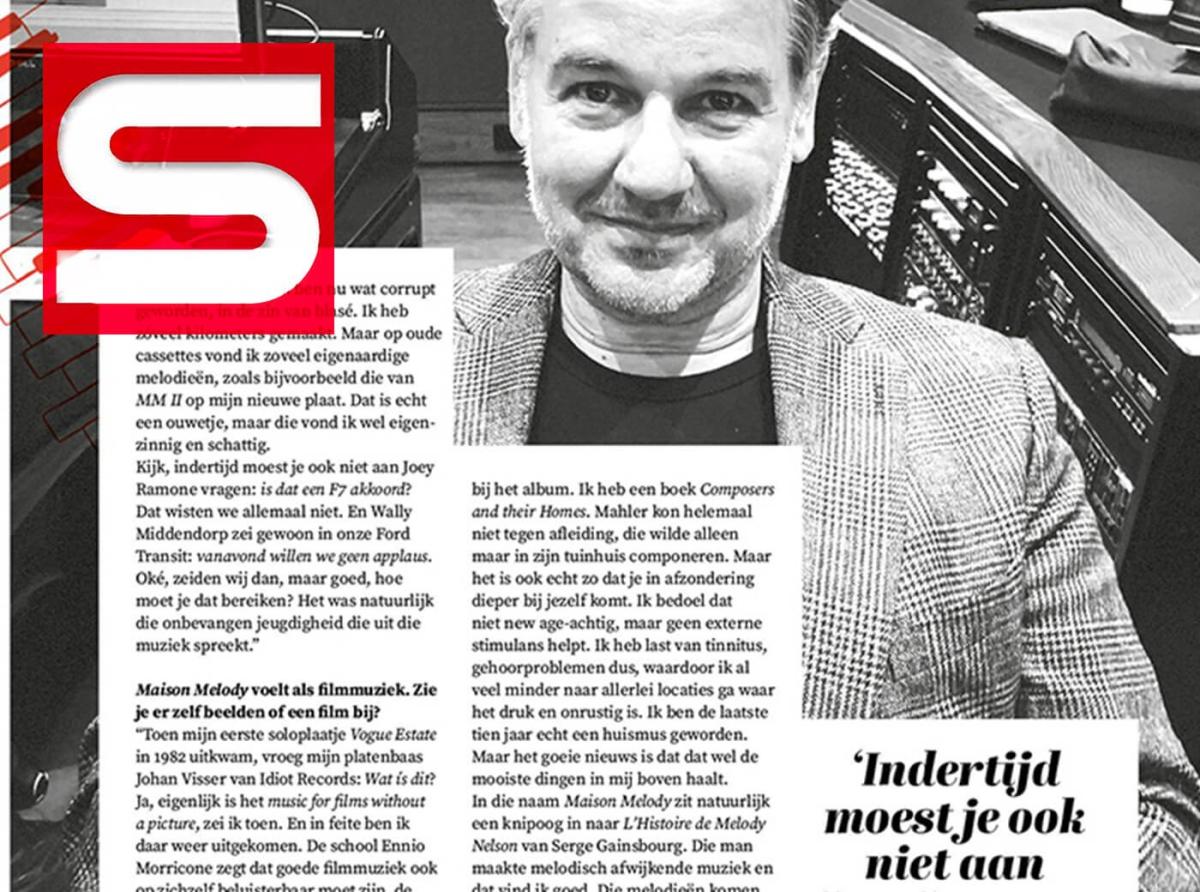
Stephen Emmer is probably the most listened-to composer in the country. His music can be heard somewhere on television in the Netherlands approximately every 7 minutes. In March 2020, he won the Buma Oeuvre Award. Soundz spoke to him about his new album ‘Maison Melody’. If you're Dutch you have almost certainly heard his music. He created theme tunes for the NOS Journaal, RTL Nieuws, RTL Boulevard, RTL Late Night, and Editie NL. And five hundred more.
He worked with Lou Reed, Midge Ure, Chaka Khan, Yoko Ono, and the list is almost endless. Tony Visconti, producer of several Bowie albums including ‘Heroes’, said of him: “Stephen is one of those musicians who knows the musical rules best and can therefore break them like no other.” Emmer not only breaks musical rules, he also defies commercial laws. Via spoken word, experimental music, and soul, he has arrived at lyrical modern classical music on his latest album, Maison Melody.
“With my previous album, Home Ground, a former Virgin boss already said to me: ‘Yeah, yeah, changing all the time. Commercial suicide.’ Then I said, ‘Yeah, in my life that’s called artistic survival.’ And that’s what it is. Artists I admire do that too. Elvis Costello, who records with The Roots one time, and with Burt Bacharach or the Brodsky Quartet the next. Or Aaron Dessner, the guitarist of The National, who also does things for the classical record label Deutsche Grammophon, and Johnny Greenwood of Radiohead, who composes modern classical film scores.”
With those last two, Dessner and Greenwood, you’ve got artists you know that your new record reminds you of. I also sometimes hear something of the lyrical pieces by Ennio Morricone. “Ennio is, of course, an old hero. From Ennio’s music, I can draw parallels to that French band Air. Those little lines, I keep returning to them. For this new album, I’ve written a few new melodies, but there are also a few from my younger self. Back to the awkwardness of my wave days.”
In the late seventies, Stephen was the guitarist in the Minny Pops. That band’s music, with Wally van Middendorp’s manic vocals, abrasive guitar parts, and angular drum machines, was downright disruptive. “We couldn’t really play very well, but we did have some really good songs sometimes. Instrumentally, they were sometimes a bit two-dimensional. Not very deeply layered; they were more lines, riffs. I was also a line scribbler, like so many back then. But now I can do something with it. I can harmonise more deeply, I can play with it. I’ve become a bit corrupted now, in the sense of blasé; I’ve put in so many miles. But on old cassettes, I found so many peculiar melodies, like for example the one from ‘MM II’ on my new album. That’s a real oldie, but I found it quirky and cute.”
“Look, back then you shouldn’t have asked Joey Ramone ‘is that an F7 chord?’ We didn’t know that at all. And Wally Middendorp just said in our Ford Transit, ‘tonight we don’t want any applause.’ Okay, we’d say, but anyway, how are you supposed to achieve that? It was, of course, that uninhibited youthfulness that speaks through that music.”
Maison Melody feels like film music. Do you picture images or a film while listening to it?
“When my first solo record, Vogue Estate, came out in 1982, my record boss Johan Visser of Idiot Records asked: ‘What is this?’ Well, actually, it’s music for films without a picture, I said back then. And in fact, I’ve moved on from that. The Ennio Morricone school says that good film music must also be listenable on its own merits; the Vrienten school says that it must be subservient. I belong to the Ennio school.”
And where does the name Maison Melody come from?
“That is what I call my studio. I lead a reclusive life; I compose at home. That was my actual starting point for the album. I have a book called Composers and their Homes. Mahler couldn't stand distractions at all; he only wanted to compose in his garden house. But it is also really true that in solitude you get closer to yourself. I don't mean that in a New Age way, but the absence of external stimulation helps. I suffer from tinnitus—hearing problems, that is—which means I go to all kinds of busy and noisy places much less often. I have really become a homebody over the last ten years. But the good news is that it brings out the most beautiful things in me.
The name Maison Melody naturally contains a nod to Serge Gainsbourg’s L’Histoire de Melody Nelson. That man made melodically unconventional music, and I like that. Those melodies come from inspiration by Chopin, and he just happens to be the father of romantic piano music.”
Besides Chopin, I also saw the name Satie listed among your sources of inspiration.
Yes, Eric Satie is the founder of what he himself called Musique d’ameublement, furniture music. Brian Eno picked that up again for his ambient music, Music for Airports. Music that is interesting and at the same time easy to ignore, as he himself says. Ambient minimal stuff. In my research, in my semi-old age, I came across the Spanish Satie, Frederico Mompou, and I suddenly discovered Leo Smit, a Dutch-Jewish composer who was deported by the Germans in 1943. Those people, they are melodists. I miss that a bit in the neo-classical music scene, that lyricism. And I do hear that in Mompou and Smit. In much of that new classical music, I don't hear themes, only repetition. You can focus nicely on that, says Spotify. But I don't want to go into that corner; I just want melody.
Someone else I admire very much is Ryuichi Sakamoto. He writes melodies, but he understands like no other, from his work with Yellow Magic Orchestra, what you can still do with atmospheric you can add layers to this kind of music. Just like I used electronics.
I noticed in my old self, through those cassette tapes, visiting my own musical youth, that I never fully went along with soundscaping alone. I’m all about melodies and themes. And when I saw Jóhann Jóhannson at Paradiso, that’s when I was triggered. I saw young people, roughly between twenty and forty, for whom that music hit very hard. The crowd was idolising him. And then I thought: he works with melody and a very limited instrumentation, he comes across as vulnerable; that is just amazing. I wanted that again too. It was truly a eureka moment.”
The transition from Home Ground, your previous album full of orchestral soul music, is huge. From Marvin Gaye and Charles Stepney to Satie and Sakamoto. It is quite a leap.
“I have been guilty of building sugar cakes. Just stacking them up, a hundred tracks, everything very layered, with famous guests. But now my story is more my true philosophy: less is more. I actually hate musicians who constantly want to show off, ‘look how many notes we can play.’ This time, I didn’t want to stand on the shoulders of all those celebrities. Just baring it all myself, with a limited lineup.”
Is this your lockdown album, then?
“Yes, actually it is. I had a hangover from building all those musical sugar cakes with all those famous collaborations. Midge Ure said two albums ago: this is going to be your logistical nightmare. And indeed, because just try calling Julien Lennon, Chaka Khan, or Lou Reed back then: ‘I have a slot at De Wereld Draait Door, can you be there tonight?’ So that’s not going to happen, which severely restricted my live options. Now I only have four string players and—I hope you heard this too—some subtle electronics. I recorded the album with fellow pianist Marcel Worms, three string players from the Metropole Orchestra, The West Side Trio, and Dimitrie Leivici. Those ladies from the Metropole do things no one else does. They run their sound through all kinds of effect pedals. That wasn't what I was looking for, but they are certainly unique ladies. In those Scandinavian neo-classicals, the strings have become very smooth, very icy. I didn't want that, so I asked one lyricist to join in, Dimitrie, born in Bucharest. How gypsy do you want it to be? He absolutely delivered. It cuts through your soul. That man also played on original MFSB records, by the way—that Philly-soul by Gamble & Huff.”
And so we are back to soul. That was the music style Stephen’s father, former news anchor Fred Emmer, was so fond of. He passed away last year on Christmas Eve.
When I listen to Maison Melody, I also hear a melancholy. Does that have to do with the passing of your father?
“Of course. I just try to process everything honestly in my music. When he passed away, I was still working on the music for the final pieces, and they have become somewhat more melancholic. But that’s okay. He was a soul man. Yesterday, I showed Fred’s old radio-cassette recorder to my daughters, their grandfather. I pressed the play button and we heard Barry White. So Home Ground was his record, but I would have loved for him to have lived to see it, just like that award I won and the fact that I was about to get married. But now it’s too late. All those emotional states are contained in those final pieces anyway. No one will be bothered by it; it is abstract.”
[Soundz - Leo Blokhuis]
Listen to Maison Melody on your favourite platform here
Or buy the digital version of Maison Melody here