Too Louis van Gaal-esque
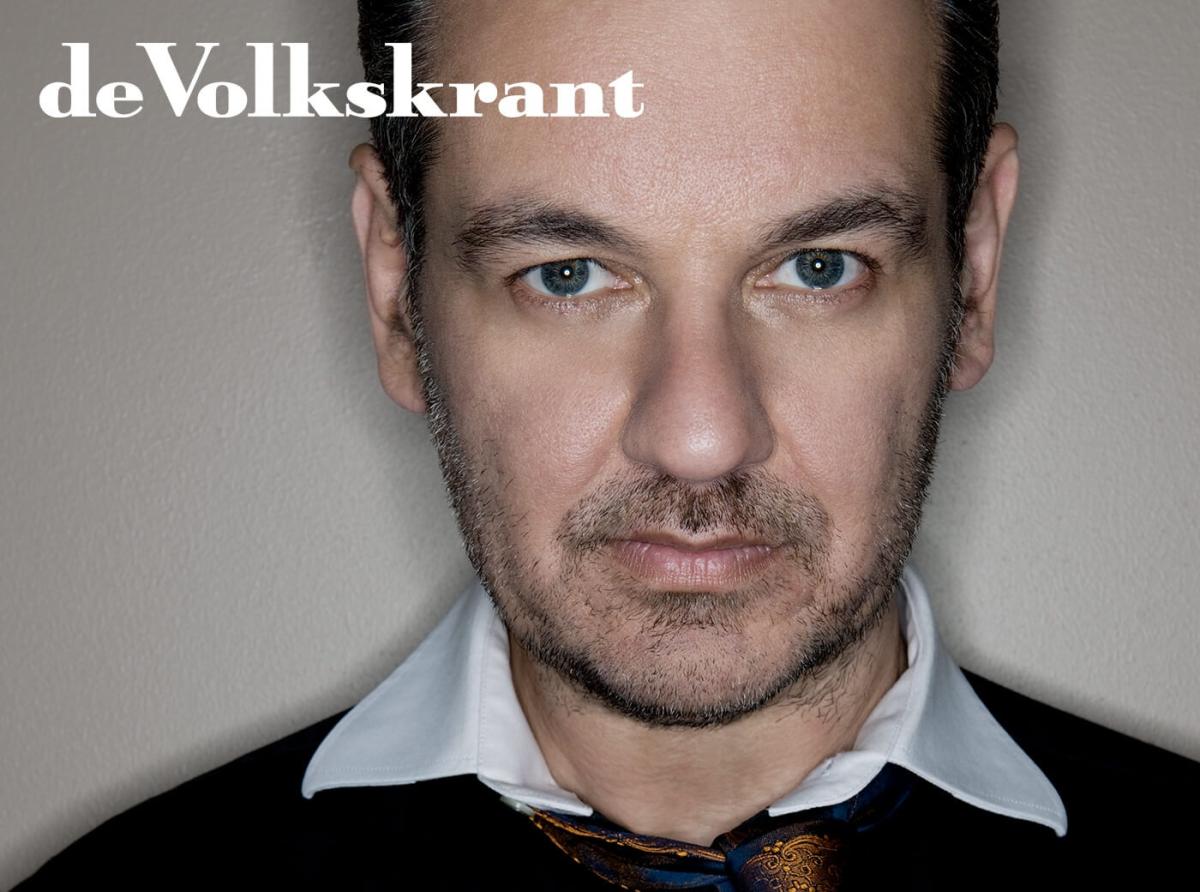
You hear the music of composer Stephen Emmer (60) night after night on countless news broadcasts and talk shows. But the world of tunes became too Louis van Gaal-like, Emmer thought, and in 2014 he became a ‘regular’ musician again. With success: he recently won two American music awards.
Global Music Awards for Home Ground
On the grand piano, one of the many instruments in the cluttered apartment just behind the Amsterdam Concertgebouw, stand two of the four American music awards that Stephen Emmer (60) won with Home Ground. With the 2017 album, he won two prizes at the Global Music Awards, where composers and instrumentalists are primarily honored. In April, with Soil, a song on that album, he won the audience and jury prizes at the Independent Music Awards, which focus on individual artists and served as judges. Tom Waits and the entire metal band Slayer, among others, were on the jury.
The fact that the awards might be unknown to the general public does not bother Stephen (pronounced: Steffen): ‘I am childishly happy with them. They are awards based on music content. With these organizations, unlike with a Grammy for example, how popular you are on YouTube or Facebook does not count. ‘They really only listen to the music.’
On Home Ground, an album featuring classic symphonic soul and lush compositions, the songs deal with Syrian boat refugees, racial tensions in the United States, and the oppression and rape of women in India. Emmer wrote the lyrics largely himself. He dislikes the sound of his own voice, so he did not sing.
For each track, Emmer enlisted a different artist, including the world-famous Chaka Khan (known for, for example, Ain’t Nobody). ‘I dove into the history of protest music. What I discovered was that much protest music is primarily a textual indictment of society. In this context, the music often serves a dull accompanying function. But I also stumbled upon honest, heartfelt soul from the mid-seventies, the era of Marvin Gaye and Curtis Mayfield. That is when I discovered that you don’t need aggressive music at all if you want to report on conflicts lyrically, as you sometimes hear in hip-hop. Soul is soothing; its gentleness can also be put to good use for a less pleasant message.’
International learning experience
Stephen Emmer is the son of Fred Emmer, who was a news anchor for the NOS Journaal from 1962 to 1987. His parents divorced soon after the birth of their only child. His mother, Roekie Aronds, an actress and ballet dancer, took him to India, Suriname, and Aruba, where Stephen took his first steps in the music world.
‘In India, I was taught local flute technique, on a different scale than do-re-mi. And in Suriname, my mother taught dance on behalf of the Dutch government. It was like: teach them some European civilization. She played Stravinsky, but the Surinamese didn't care for that. She resigned, started her own dance school, and was faced with a choice: are we going to exhibit colonial behavior or join forces with the local people? It became the latter.’
Emmer took lessons in apinti (Surinamese conga) from Maroons. ‘On that, you don’t play tame rhythms, but primitive, refined polyrhythms. My mother had an eclectic repertoire featuring Hawaiian voodoo, music from the American musical West Side Story, Mexican mariachi, or Brazilian samba. You didn’t hear any of that here yet, in the land of Willem Duys. In hindsight, it was a great learning experience.’
As a 15-year-old, Emmer returned to the Netherlands in 1973. He became a guitarist in the new-wave group Minny Pops in 1977 and contributed to the founding of music magazine Vinyl in 1981, but chose to become a solo musician at a time when the synthesizer was gaining ground and the multitrack cassette recorder was arriving from Japan. He bought a recorder and composed his first album in 1982, the instrumental, cinematic Vogue Estate. “There’s the new Mike Oldfield,” people said after a Paradiso performance. “No, I actually wanted to distance myself from the old seventies rock that Oldfield made. I was a new-waver.” The somewhat dark new wave stemmed from punk and was a reaction to that more bombastic seventies rock.
TV Tunes
A designer from the Humanist Association had heard his record and asked Emmer to compose the theme music for the program Kwartslag. ‘Why not?’ I thought. I started taking the title seriously: there are four beats, so quarters, in the measure. Seconds indicated the tempo.’ Emmer added saxophone and piano to it. He also began to immerse himself in video editing and 2D animation through crash courses. He did this to understand the mindset of his video editor. Revolutionary: until then, the audio and video departments barely interfered with each other's work. That combination of image and music caught on. ‘That is why my phone hasn't stopped ringing for the thirty years since.’
He rolled from one job into another. Emmer became the first full-time theme music composer. He created theme music and tunes for many news broadcasts (NOS, RTL, Editie NL) and programs (*Per Seconde Wijzer*, Waku Waku, RTL Late Night). Including RTL Boulevard. ‘Setting showbiz to music was quite a quest back then. After all: what does gossiping sound like? I had a cheesy saxophone in mind, the kind you might hear in a karaoke bar in Tokyo, or that terrible Kenny G from America: a very slick sound. I put a sort of naughty, double-time breakbeat (a sequence of notes that follows itself twice as fast, ed.) underneath it, with a manic little arrangement built around that sleazy saxophone. When I handed it in, people said: whatever. But in hindsight, I did set an example, because I later heard a similar little saxophone on SBS Shownieuws.’
The musician created thousands of tunes. ‘Of course, there were times when it was: goddamn, what a hassle and fiddling. It’s a mosaic, which also contains a kind of banality. Just like with pop songs, it suddenly works.’ Emmer was dubbed the Seven Minute Man in the media because one of his tunes appeared on TV every seven minutes. Yet the fun slowly faded away. ‘In the past, you could make coffee during a theme tune, but it had to get shorter and shorter. You were given less freedom. Take the NOS Journaal. During the underscore (atmospheric music that continues while the headlines are being told, ed.), after a Western orchestra, I had very softly inserted an inverted Tibetan singing bowl. There is already so much misery, I thought, let’s reassure the audience instead of inciting them.’ Such frivolities became increasingly difficult to get through. ‘The theme tunes didn’t have to be so distinctive anymore either. Clients said: I want something that looks like that RTL theme tune. Pure pastiche; it became a world of imitation. I no longer had direct contact with broadcasters, but with advisors to broadcasters. It gave me a Louis van Gaal-as-a-football-coach feeling: being extremely serious with a heavy hand about something subordinate. Ridiculous.’ ‘Fortunately, I had earned money to create freelance work again.’
Back as a musician, he drew inspiration from his father, from whose shadow he still had to emerge. ‘People still try to reach my father through me. Then I think, gee, I’m 60. But anyway, he was on television daily in a time of few channels and stars.’ The image of the proper, decisive-speaking news anchor changed completely when Fred wrote a collection of erotic stories in 1987 and spoke about it on TV with Sonja Barend. ‘Horrible, yuck. It was shocking that a news anchor, an incorruptible authority of, say, the announcer of John F. Kennedy’s death, was going to write such stories.’ It made Stephen insecure around women. ‘This was very much in the snickering circuit. Parents of women would say: that is the son of the gentleman who writes dirty books. Girls would echo their parents to me.’
Dad’s flair for language and speech did help him, though. ‘He spoke the same way at home as on TV and corrected anything that deviated. “You put the emphasis wrong,” he would say loudly and intimidatingly. In hindsight, my father’s work gave me the advantage of being able to hear whether someone could recite well. I put on a cassette by the Welsh actor Richard Burton, the Rolls-Royce of voices. Burton was reading poems. I heard what he was doing: starting, stopping, slowing down, and speeding up like a skilled speaker—just like my father—can. I played guitar along and thought: this is something.’ A spoken word album followed: Recitement (2007). Hugo Claus and Remco Campert, among others, recited literary texts.
Visconti and Reed
The album Recitement (2007) was produced by Emmer together with David Bowie’s producer Tony Visconti. An assistant of Visconti’s discovered Emmer’s demos on MySpace. ‘Visconti thought I was working on an arty Dutch project and asked to finish the album with him in New York.’ Emmer asked if Visconti, also a backing vocalist on Bowie’s album Heroes, would like to recite a text as well. Visconti declined, but put forward the voice of the now deceased rock star Lou Reed, who speaks on Passengers.
After this album, Emmer chose to stay out of the spotlight for six years, partly due to a divorce and tinnitus (ringing in the ears). Composing became difficult with tinnitus. ‘The profession also involves picking up casual tones, like a church bell. But I couldn’t hear such tones anymore because of that constant ringing. So I started arranging pieces for others, because that was still possible.’ He arranged compositions for The Lotus Eaters, an English band. When his tinnitus subsided, he felt the urge to get involved with composition again.
In 2014, Emmer started making music himself again. The album International Blue was a hymn to crooners. Three years later came Home Ground. Beyond the national borders, that album broke free from the Fred yoke, without maneuvering himself into the spotlight. ‘I see myself as a lab technician or alchemist, brewing music in a safe studio environment. That is what I like doing best. I also stopped doing live music quickly, because I am wooden and a boring person on stage.’
[Terence Garnier - Volkskrant]